Recovery is a computer.
We ship it ready.
When you reach infrastructure zero, the Meshfire node stands up your trusted network, directory, and offline AI assistant from a dead start.
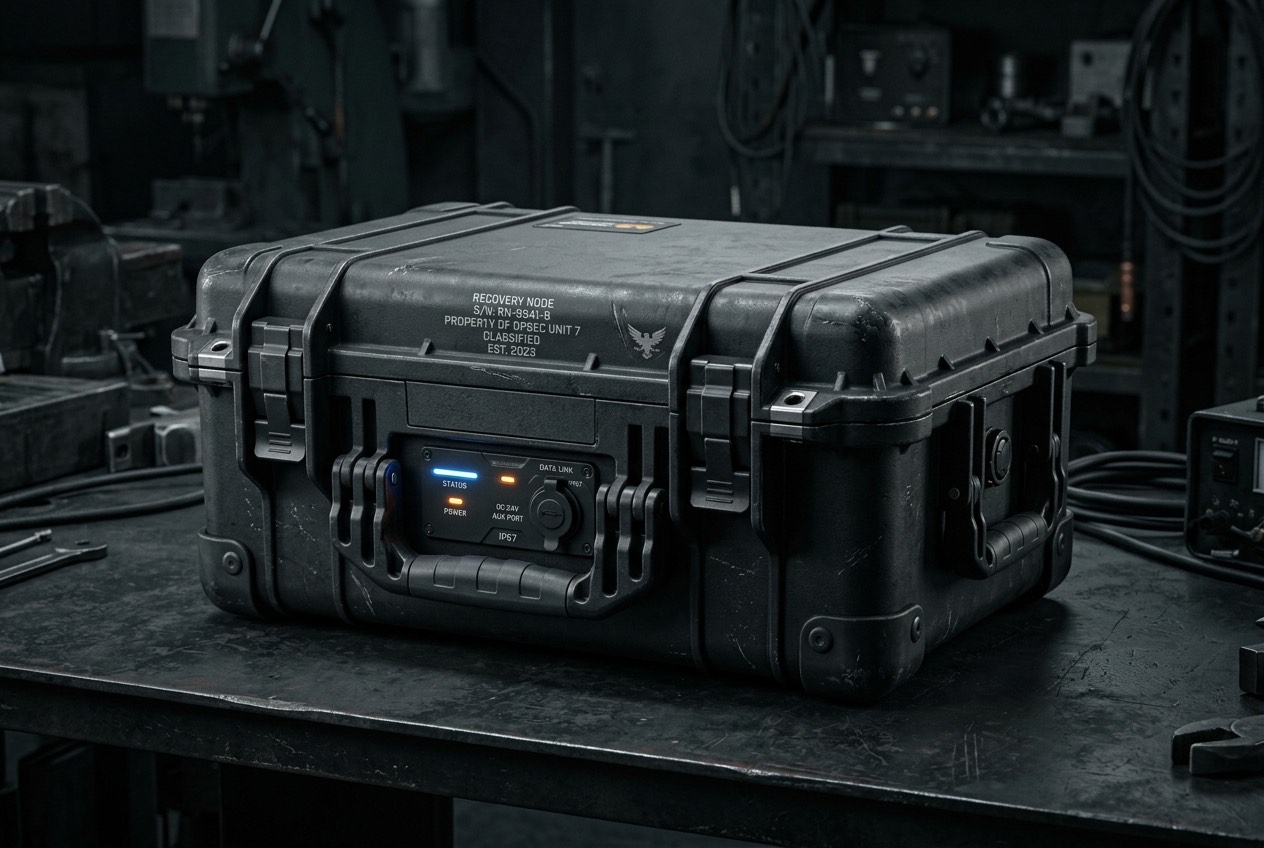
Your recovery plan assumes the infrastructure survived.
Typical communications infrastructure relies on power, backhaul, and cloud services. In a crisis, these dependencies become vulnerabilities.
Natural Disasters
Following severe weather events, municipalities often face downed cell towers and severed fiber lines. The DR plan existed, but it assumed the towers — and those were the casualties.
Cyber Incidents
When utilities isolate their networks during a cyber incident, conventional communications channels are severed. The DR plan existed, but it assumed the directory — and that was the casualty.
Field Operations
Mass gatherings and remote field deployments frequently exceed the footprint of commercial cellular networks. The DR plan existed, but it lived in the cloud — and that connection was the casualty.
The Recovery Node
Enterprise-grade networking, edge computing, and multi-modal backhaul. Hardened into a single ruggedized case built for true zero-trust operation — operates air-gapped when deployed without uplinks — where your data never leaves the box.
The node is the product. Everything else is a layer.
At the center of every Meshfire kit is the recovery node: a compact computer that ships pre-configured for the worst day — network and directory services ready to stand up a trusted environment from zero, recovery runbooks staged, and small language models loaded with your procedures, running with no internet at all.
The case, the batteries, the radios: all replaceable, all partner-supplied. The node is what makes it recovery instead of just reconnection.
Open interfaces at every layer. Bring your radio, your power, your case — the node makes them a recovery system.
It thinks offline.
When cloud AI providers are unreachable, the Meshfire AI module takes over. Embedded directly into the case is a dedicated edge compute node running localized Small Language Models (SLMs).
- 1
Offline AI — Zero Internet Required
The crisis assistant functions entirely on the local hardware. No API calls, no cloud processing, no latency.
- 2
Deploy your procedures
Ingest your operating procedures (SOPs), emergency maps, and response plans before deployment. The AI grounds its answers in your specific data.
- 3
Absolute Privacy
Your data never leaves the box. Period. Feed the assistant sensitive tactical or critical infrastructure information without compliance concerns or third-party exposure.
What you load → What you get
Select a prompt:
In deployment, this runs on your documents — loaded on-site, never leaving your custody — with languages validated per deployment.
Your data never leaves the box.
Offline by design
The node serves answers with zero internet connectivity; no cloud dependency, no external API in the response path.
Your documents, your custody
Plans and procedures are loaded on-site, stored on the node, and never transmitted off the device.
No telemetry
The node does not phone home; nothing about your usage leaves your environment.
American components, auditable stack
U.S.-origin models and software throughout; component provenance documented per deployment.
Full security architecture documentation is provided under NDA in pilot briefings.
The Field Kit — reference implementation
Meshfire kits are built on enterprise components providing reliable connectivity in austere environments. Kits are designed for extreme ruggedness without compromising portability.
Meshfire Scout
Portable 5G Tier
- • 5G/LTE router with eSIM + dual physical SIM
- • 4x4 MIMO cellular across the full 5G spectrum (600 MHz–6 GHz class)
- • Wi-Fi 6
- • Battery + AC power
- • Rugged carry-on-class case
- • Meshfire AI edge module
Meshfire Sentinel
Hybrid Satellite/Cellular Tier
- • Ruggedized next-generation firewall with dual 5G radios
- • Wi-Fi 6 access point
- • Satellite-mount option (dish and service sold separately)
- • SD-WAN orchestration across cellular/satellite/Wi-Fi/Ethernet
- • Zero-trust enforcement
- • Battery + AC dual power
- • Meshfire AI edge module
What's in the box
In the case:
- Rugged transport case
- Meshfire recovery node (pre-configured, your documents loaded at deployment)
- Enterprise-class firewall/router with cellular backhaul
- Wi-Fi 6 access point
- Antennas and cabling
- Battery + AC power kit
- Laminated quick-start card ("the first 60 minutes, on one page")
Not included (told to you up front):
- SIM cards and carrier service
- Satellite dish and satellite service subscription (satellite-tier kits accept the mount)
- Extended power options (solar/long-runtime — partner add-ons, quoted with your configuration)
Every kit is configured to the mission — the contents above are the reference configuration.
All third-party trademarks are property of their respective owners. Meshfire is an independent company.
Inside the case
One latch. Five layers. A recovery system.
Every Meshfire field kit packs the same architecture: swappable connectivity, power, and transport layers around the one component that makes it recovery instead of reconnection — the node.
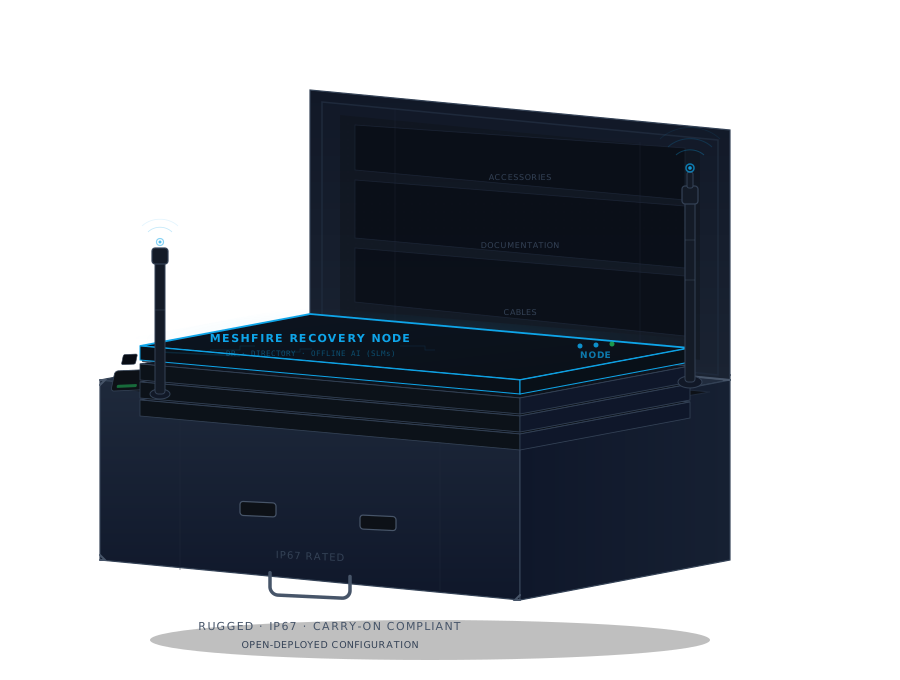
What's in the box
- • Meshfire recovery node (edge compute, pre-configured)
- • Enterprise-class firewall/router with cellular backhaul
- • Wi-Fi 6 access point
- • Antennas and cabling
- • Battery + AC power kit
- • Rugged sealed transport case (carry-on compliant)
Concept illustration of the field-kit reference configuration — component classes shown; not a product photograph. Final configurations pending.
One box is a lifeline.
Ten are a grid.
Meshfire units automatically detect and connect to one another. Deploy multiple kits across an incident zone to instantly rebuild a self-healing communications backbone spanning miles.
Built for the RTO nobody plans: infrastructure zero.
Recovery Time Objective — the maximum acceptable time a system can remain down after a disruption (NIST SP 800-34).
First minutes
Trusted network and Wi-Fi stand up from the node.
First hour
Teams connect; the offline assistant serves your procedures.
First day
Departments operate on the mesh while infrastructure is rebuilt.
Illustrative recovery sequence — actual timelines depend on deployment scope
The first 60 minutes.
Illustrative sequence — timings are design targets and depend on deployment scope.
T+0
The latch
Power is out. Towers are overloaded. Someone carries a case into the EOC and opens it.
T+5
A network exists again
The node boots, the firewall stands up, and a clean Wi-Fi network appears — trusted, because nothing legacy touches it.
T+15
The team plugs in
Phones and laptops join. The offline assistant is already serving your own procedures — no internet, no cloud, no waiting.
T+60
Operations, running
Departments coordinate on the pod. If more pods are up, they've meshed into a backbone. Recovery is underway while the old infrastructure is still dark.
Who It's For
Meshfire is engineered for organizations that cannot accept downtime, no matter the external conditions.
Municipalities & Counties
Equip Emergency Operations Centers (EOCs) and public works departments with a drop-in network that survives extreme weather events and natural disasters.
Utilities & Critical Infrastructure
Maintain command and control during grid failures or cyber incidents when primary networks are compromised, overloaded, or deliberately isolated.
Event Security
Establish immediate, high-bandwidth local coordination at incident scenes, far beyond the reach of commercial cellular towers.
Events & Field Operations
Deploy temporary, secure, high-capacity infrastructure for mass gatherings where civilian network congestion renders commercial service unusable.
A connectivity kit gives you a pipe. Meshfire gives you a plan.
The hardware category is proven. What's been missing is the intelligence that works when the cloud doesn't.
Meshfire Ready — an open reference architecture
The recovery node is built on open interfaces. We're forming a partner program for the vendors whose layers belong in the box — because when a customer's environment goes down, what's inside the recovery node is the only shortlist that matters.View the draft reference architecture →
Private 5G & spectrum
Certify your Private 5G & spectrum layer against the draft reference architecture.
Satellite backhaul
Certify your Satellite backhaul layer against the draft reference architecture.
Power & energy storage
Certify your Power & energy storage layer against the draft reference architecture.
Rugged transport & cases
Certify your Rugged transport & cases layer against the draft reference architecture.
Network security
Certify your Network security layer against the draft reference architecture.
Compute hardware
Certify your Compute hardware layer against the draft reference architecture.
Who's behind Meshfire
Built by veterans of emergency management, critical infrastructure protection, and enterprise cybersecurity.
Founders
Meshfire is built by two founders with careers inside the industries we serve: one from enterprise cybersecurity — channel, identity, and incident-driven sales at scale — and one from network and security vendor engineering with deep public-sector compliance exposure. We're in stealth; founder identities are shared in every pilot briefing.
The team we're building
Open Role
Founding Engineer — Edge AI
small-model serving, retrieval, and hardening on resource-constrained hardware
This could be youOpen Role
Field Operations Lead
ex-emergency-management or responder background; owns pilots and readiness exercises
This could be youOpen Role
Public-Sector GTM
grant-path selling, cooperative purchasing, SLED procurement
This could be youProcurement & Funding
Your purchase may be grant-eligible. We'll help you build the justification.
Find your funding path
Frequently Asked Questions
How to engage
Pilot briefing
A 45-minute session on your scenario, your infrastructure, and where the recovery node fits.
Configured proposal
Every Meshfire kit is configured to the mission; we scope your configuration and quote it. No price lists, no one-size-fits-all.
Pilot deployment
A scoped pilot with success criteria, then scale on your procurement path (direct or cooperative contract).
Most organizations start with the briefing.
Start with a briefingRequest a Pilot Briefing
Schedule a technical walkthrough and discuss deployment scenarios for your organization.
Briefing Request Received
Thank you — we'll get back to you within one business day to schedule your technical walkthrough.